The group with which Henry was connected at ETH in Zurich definitely knows how to mix work and fun. They convene for Friday lunches, rotating responsibility among the graduate students for preparing the weekly repasts. Henry made his contribution by our taking everyone to lunch at an Indian restaurant on the final Friday of our Zurich sojourn. The group also "retreats" to the mountains for skiing in the winter and hiking, rock climbing, basketball, windsurfing, and/or kitesurfing in the summer. Henry's ETH host kindly invited us to join the group in Promontogno, in the Swiss Alps, just a few kilometers from the Italian border. The grandfather of one of the students owns an apartment in this small village tucked in an alpine nook. The professor and ten students managed to divide up the rooms in that and the adjoining apartment, while Henry and I stayed in a homey pension across the street. The pension appeared to be a family affair, with the matriarch staying up each night until we returned to our room after partying with the retreating group into the wee hours of the morning. During the day, we found the older woman steam pressing the linens while her helpers folded them.
 Getting to Promontogno was an ordeal in itself. Aside from the usual traffic exiting Munich, we came to a standstill on the Autobahn toward Switzerland (see photo of two possible future leaders of their country hanging out of the windows of their car), because of terribly inconvenient construction work. As we continued south into the Alps, the heavens opened up and it poured (except when we were driving in the countless tunnels the Swiss have blasted through the mountains). Despite the many tunnels, we still needed to drive the windy roads over several passes. Henry maneuvered the rental car (a relatively large Mercedes A180 hatchback, with automatic transmission), even though it was not the small, manual transmission car we had reserved. Perhaps the Hertz agent considered us to be her stereotypical American tourists, all of whom like to drive big cars and cannot handle manual transmissions. When the shoulderless roads are as narrow as these were, with a high cement wall on one side and a barrier on the other, the last car we wanted was one that was wider than the single lane available!
 Promontogno is peaceful oasis between the classy (assuming that is defined by the number of 4 and 5-star hotels and local branches of Hermes, Channel, Gucci, and similar shops) and touristy St. Mortiz, and the lively Italian city of Chiavenna.
  It makes no attempt to attract tourists through kitsch and gimmicky attractions.
  The village offers only its natural beauty (see photos--the view with the bridges is from our private patio outside our hotel room; also, notice the widespread use of slate as roofing material; the photo of the two of us shows more natural beauty (of course), and that the two of us actually do spend time together in the same place at the same time!). And, even better for me, it was quiet enough for Henry to permit me to keep our room window open all night!


While we enjoyed the serenity of Promontogno, we also succumbed to the lures of St. Moritz and Chiavenna for lunches (see photos). Both places were fine for a meal, but I'm glad we had our room in Promontogno.  The best part of going to St. Moritz was our stop at Lake Silvaplana, a haven for windsurfers and kitesurfers.
 I have never seen so many of them vying for a piece of the perfect wind. I was mesmerized as the kitesurfers let the wind fill their "sail" and efffectively lift them onto their small surfing boards. The especially talented kitesurfers could hang on with one hand and could pick up enough speed to lift themselves out of the water, do an aerial twist, and land seemingly effortlessly back on the water. Unfortunately, my Canon G7 digital camera isn't quite advanced enough to capture the full scene. What I could get, however, was a sense of how intense these surfers are. They come in their RV's and camp out on the lakeshore so they can be ready for just the right wind (see photos)! The best of Chiavenna was the ice cream from Gelateria Oasi.
  The better than best were the innumerable waterfalls dropping down the mountainsides between Chiavenna and St. Moritz, as well as along the mountain pass roads. One double falls we were able to walk to was the impressive Acquafraggia, just south of the border, near Piuro, Italy (see photo). The pool at the bottom of the falls and the continuing runoff are popular spots for cooling off on a warm summer day.
Oops, there was another Chiavenna highlight--the supermarket the students drove to for stocking up on food and liquid refreshments (i.e., wine and grappa). Food and drink are significantly less expensive in Italy than Switzerland. It's no wonder that Chiavenna can support several supermarkets! However, the Swiss border guards strictly enforce the country's limits on how much food and alcohol individuals can bring back into the country, e.g., 500 grams of meat, 2 liters of alcohol per person. The students' solution--5 of them pile into one car for the food and drink run. On their first return, the guards pulled them aside and spent 10 minutes unsuccessfully searching for any overage. Henry and I did our part, bringing back four bottles of wine and a selection of cheeses.
Our best meals were the two dinners prepared by the students and one dinner with the group at the Crotto Quartino in a chestnut grove in Santa Croce di Piuro. The menu is printed on the napkins and placemats and is limited to a list of about 7 items--you can choose any number of them or all of them. The gnocchi and grilled ribs were especially outstanding.  The evenings with the group were not complete until we performed karaoke (see photo). The students, who hail from an assortment of countries in addition to Switzerland (Germany, Poland, Russia, United States, Taiwan, and Turkey), were far better than we were at singing the mostly English language songs. The last evening, we were also treated to a video of the group's past two retreats. We laughed hysterically as two of the Swiss students "helped" the Taiwanese student try to master the mysteries of skiing. One held the video camera as the other skied behind their "student" while holding onto a rope around their student's waist. It was all in good fun, with everyone, including the Taiwanese student, being a great sport.
Henry and I took an extra day to drive back to Munich, stopping for the night near the Bodensee (Lake Constance), a large lake between northern Switzerland and southern Bavaria. 
 On my suggestion, we took a detour to Arosa (another Swiss alpine ski town (see photos)), thinking it would be a short side trip for lunch. Having temporarily misplaced our detailed Swiss Michelin map, we didn't realize that the 31 kilometers to Arosa was on a tiny, windy byway. On the small Swiss map we did have, Arosa looked so close to Chur (our detour point from the main road)! Alas, a sign posted by the road as we exited Arosa announced only 355 curves ahead! Well over an hour into our "short" detour, we arrived at Arosa, hungry but very satisfied that we had encountered some fantastic scenery along the way. Our lunch at Kachelofa-Stubli, once again a Michelin red guide pick, was outstanding. I do not recall why I did not choose Arosa as a skiing destination while we were living in Zurich, but I noticed that the tram up one of the mountains was literally across the street from the train station. I am sure the train would have been a much less stressful mode of transportation to this destination resort! We had no choice but to return to the main highway the way we came, but as we "re-wound" (or should that be "unwound"?) our way back, we made several stops to take in the views at a more leisurely pace.
  Later, enjoying our view of the Bodensee from our pension in Kressbronn am Bodensee (see photo) and having dinner at Lamm im Kau in Tettnang-Kau (one more red Michelin pick), were two more treats with which to finish off our Swiss retreat.

 Days like the one I spent in Mittenwald don't occur too often. I don't know whether the stars were aligned because it was daylight (joke), but the weather could not have been better for a couple of Mittenwald hikes. The temperature hovered in the low 70's, a gentle breeze followed me most of the day, and I had just enough energy and courage to cross the steel walking bridge high over Leutaschklamm (gorge) (see photos below). Mittenwald, a fairy tale looking town about 20 minutes southeast of Garmisch, has plenty of "local color" to offer. Many commercial and residential buildings have frescoed facades, some of them passing up the usual religious themes in favor of themes depicting traditional mountain life (see photo). The town centers around the cathedral, itself attractively painted on the outside (see photo) and ornate, but not quite "over-the-top", on the inside. My goal for the day was not to tarry in town, but to check out some of the highly regarded wanderwegs in the area.


 I initially rejected the gorge hike, based upon pictures of (1) the bridge crossing the gorge, and (2) the steel grated walkway embedded in the side of the cliffs about 200 feet above the raging river below. Despite my family's laughing at my beelines to the "i" (aka "tourist information center"), I got just the information I wanted at the Mittenwald "i", even though some of it was inaccurate! In order to get some idea of the height of the steel bridge above the gorge (and having learned from my litigation days that people do much better at estimating a height when they can compare it with another known object), I offered to the "i" attendant the bridge near Neuschwanstein (see blog entry "A Week to Relax") for comparison. The young woman assured me this bridge was not even half as high as the Neuschwanstein bridge and she estimated it to be no more than the height of the three-story house across the street from us. She also assured me that I could avoid the steel walkway embedded in the cliff simply by crossing the bridge and continuing along an alternate hiking path. So much for accurate reporting! When I arrived at the highest point before the bridge, I could see neither the promised gorge nor the promised waterfall. As the trail descended toward the bridge, the trail turned into the grated steel pathway I expected to avoid! My choice was to turn around and return disappointed or to march forward down the grated, "see through" steel steps leading to the bridge and the desired views (see photo). Relieved there was minimal "bounce" on the steel steps, but terror struck that I would have to look down to avoid missing a step, I held on as tightly as I could to the pipe railing and kept moving. I managed to get to the bridge, but then I was stuck with the duly and dually unpleasant choice of either walking back up the steps in the side of the cliff or to cross the bridge (see photo)! Considering these options, I chose the latter route solely because of the bridge's non-grated, sheet metal walking surface. I would have run across the bridge had I been able to do so without creating the undesired "bounce". The best I could do was wait until only a few hikers were on the bridge and not blocking my way. I took off at a rapid walk, only to be held up by a group of people who stopped in the middle of the bridge. The urgency in my "Entschuldigung!" ("excuse me") was unmistakable. Although I had to slow my stride, they moved just fast enough that I did not have to stop until I reached the other side of the gorge. So much for being cool and nonchalant! I probably held my breath the entire breadth! I suppose I could, via "photoshop", insert a picture of me standing on the bridge, but the reality is I was unwilling to take a microsecond longer than absolutely necessary to span the gorge. My photos from opposite sides of the gorge are proof enough of the feat of my feet, which included walking partway along the cliff wall (see photos). The bottom line is that what makes this hike spectacular is not the gorge, but the steel walkway and bridge!
 I rewarded myself with lunch served at a mountain guesthouse (far superior to my alternative, home-prepared peanut butter and jam sandwich). Despite the fact that I arrived there at the busiest time of the day, I could still enjoy the view (see photo) while I waited to be served.


 Taking the "i" attendant's recommendation for another pleasant hike, I walked along a cascading stream to the Lautersee. My relative disappointment with the destination lake was far overshadowed by the beauty of the hike up to the lake and back (see photos). The more than I expected elevation change (definitely less than on the gorge hike) allowed for a waterfall along the mostly forested trail (see photos).
  As I approached the lake, I came upon a memorable sidelight--several chairs carved into abandoned tree trucks (see photo). The chairs were hardly comfortable, but they were throne-like nonetheless!
As I proceed through my "must see or do before we leave Munich" list, I am also enjoying museums and parks closer to our Munich home--the Pinakothek trio of museums (the Altes (with an especially large collection of Rubens paintings), the Neue (with a nice collection of 18th century works, but a disappointing collection of Impressionist paintings), and the Moderne (I can handle the Picassos and the Braques, but I don't understand the artistic significance of two parallel sets of pastel-colored strings, each set connected to the floor and ceiling in an otherwise empty white room)); Olympic Park (a still "in process" makeover of the space used for the 1972 Summer Olympics, but with a nice, grass-banked lake); and the Jewish Museum (a very interesting museum with thought provoking exhibits, despite keeping the number of "objects" to a minimum).
I am back after my "home stretch" with Sara and Brett in Del Mar (not quite home, because our house is still rented, but close enough, as Nicole Moran O'Neil and Tom O'Neil made us feel at home in their house). Now, Henry and I are in the "home stretch" in Munich, with under a month left in our stay at Amalienstrasse. The trip to California was quick, but was time well spent.Enough said about California--after all, we're on sabbatical! I arrived back in Munich last Thursday morning (7/29), had a four-hour nap, and, with Henry, headed off to Allianz Arena to watch the finals and third place football matches of the First Annual Audi Cup Tournament. In celebration of its 100th year in business, Audi sponsored a four-team tournament among the local favorite, FC Bayern Munchen, and AC Mailand (Milan), Manchester United FC (David Beckham's former team in England), and CA Boca Juniors (Buenos Aires). It was immaterial to us who won; we were there to experience international soccer first hand. Thinking that by leaving our apartment at 5:00PM for a 6:30 PM "kickoff", we would have a leisurely ride to the stadium, we were shocked by the scene at our nearby subway station. The platform was already packed with boisterous red-shirted, red-jacketed, re-hatted FC Bayern fans. When the train arrived at our station, it was filled with more similarly clad fans. The nine-station ride could not pass quickly enough considering the ease with which sweat gland secretions were transferred among the ridership. We were packed in so tightly, I had no place to hold onto a safety bar. Nevertheless, I had no worries about falling over--there was no room to fall! Woe to the few passengers who wanted to exit the train at the intermediate stops, and woe to the greater numbers of fans who wanted to get on! I was reminded of a joke my father used to tell with the punch line, "The king is coming!" As the soldiers in a stuffed room came to attention upon that pronouncement, even more soldiers could be inserted into the otherwise full room. The more modern analogy is the tram at Jackson Hole where an overload of skiers and snowboarders are vying for "first tracks".  One difference on the subway train was that the fans were constantly jumping up and down, chanting and singing FC Bayern cheers. Henry and I could join the bouncing and make lots of noise, but didn't have much of a clue what the cheers were! The arena itself is quite a sight, especially when it is lit up at night in FC Bayern red (see photo).
  The stadium is partially covered, with a retractable roof to cover the balance, if necessary. Our nosebleed seats directly behind one of the goals gave us a perfectly fine view of the field (see photo). Unfortunately, there was little scoring (1-1 and 0-0) and both matches ended with "shoot-outs", won by Boca Juniors and Bayern, respectively. I got the biggest kick out of a young boy (probably about three years old) sitting behind us. No matter that the local team wasn't playing; he regularly would yell as loudly as he could, "FC Bayern!" Yes, the cheers, the beer and hot dogs (i.e., wurst on buns), and the "wave" were ever present, but one thing that was new for us was the mandatory use of "Arena Cards" to pay for all food and drink purchases inside the stadium. One must "cash up" an Arena Card which is then used for payment at concession stands. The card has many benefits, especially for the stadium. Fans are prone to over-"cashing up", so the money is on the card whenever folks get the munchies or a beer craving. That's fine for the regulars, but not so for the one-time visitors like us. We either over-eat or end up with unspent sums on the card. The stadium wins both ways! Also, with the lines moving more quickly via cashless transactions, the concessionaires can sell to more fans! These footballers are mighty smart!The weekend brought Rod Franklin to town for another visit from Einsiedeln, Switzerland. And, once again, Muncheners were celebrating with yet another street fair.

 This one, Auer Dult, dating back to the Middle Ages, takes place in Mariahilfplatz three times a year. Merry-go-rounds, ferris wheels, bumper cars, and other rides fill one corner of the huge, extended square, while food and drink booths are interspersed among an assortment of junk dealers (some masquerading as antique dealers), sellers of toys and suspenders (they go well with lederhosen!), tableware and cookware, and the largest number of "ginzu knife" and "miracle cleaner" booths east of the Del Mar Fair (see photos)! The heat of the sun sapped my energy, but I doubt I'll ever tire of street fairs and markets!

 I'll also never tire of King Ludwig II's castles. Realizing that we are indeed in the home stretch of our stay in Munich, I traveled to Schloss Linderhof (see photos), via train and two buses, despite the rainy day forecast. The weather predictors were correct for a change, but it did not rain hard enough to dampen my spirits or slow down my camera trigger finger. Linderhof is the only castle Ludwig II managed to finish during his reign, and is a small scale version of Versailles. As is the case in his other castles, signs of Ludwig's adoration of the Sun King, Louis XIV, and composer, Richard Wagner, are present throughout.
 The wood carvings, frescoed walls and ceilings, stucco bas relief, and tapestry, velvet, and porcelain furnishings, with abundant gilding in most of the rooms, come close to, but do not quite equal the ostentation of the Neuschwanstein and Herrenchiemsee palaces. However, there is a brightness and ingenuity in the gardens and water features that I felt was missing at Neuschwanstein and Herrenchiemsee (see photos). I especially liked Ludwig's "natural" air-conditioning. All Ludwig (or his servants) needed to do to cool off on warm summer days was open the windows overlooking a man-made hillside cascade of water tumbling into a fountain next to the palace (see photo). The cool breeze generated by the water worked like a charm. Whatever sense of self-importance Ludwig II might have felt as King of Bavaria, he was definitely a loner and an eccentric fellow.
 Nearby the palace, he had an artificial grotto built with a stage and painted backdrop painted with a scene from one of Wagner's opera "Tannhauser". In front of the stage was a heated pool with a shell-shaped gondola, in which Ludwig sometimes had a servant row him around (see photo). He also had a special vantage point in the grotto from which he, as the sole member of the audience, could enjoy Wagner's opera pieces. The grotto was one of the first locations in Bavaria to be fitted with electric lights, which changed colors on demand. It also had an artificial waterfall that could be turned on and off at will. Ludwig's Wagner worship was further demonstrated in his building of a small hut on the palace grounds where he could contemplate Wagner's opera "Parsifal" in complete solitude (see photo). As a confirmed King Ludwig II "schlossophile", I left Linderhof a contented customer.
No sooner do I catch up on my blog when I go somewhere and/or do something else, and then I'm behind again. Ah me, it's the never-ending story.
The rain that dashed our plan to go to Garmisch kept us inside most of Saturday. We thought the extremely unusual day-long traffic jam on the street outside our apartment might have been the result of traffic light outages on Schwabing's main north/south street (Leopoldstrasse). However, when we wandered over to Leopoldstrasse after dinner at Il Grappolo, an outstanding neighborhood restaurant/wine bar "find" (Michelin has not "found" it yet), we discovered that Leopoldstrasse was closed from our cross street (Schellingstrasse), north for almost two kilometers, to Munchner Freiheit, for the first of a two-day "Streetlife-Festival". 
 The rain caused some booths to close down early, but it failed to put a damper on thousands of folks enjoying the live bands every few blocks, the innumerable beer stands (selling local brews (e.g., Ayinger, Paulaner) or foreign brews (e.g., Corona, Guinness) "von Fass" (from the tap)), and countless food stands (selling traditional (e.g., wurst) and exotic (e.g., American hamburger) fare). The theme of the festival appeared to be a salute to the city's environmental consciousness (e.g., "Green City" signs posted along the "Corso Leopold", sellers of solar electric panels, bicycles and bicycle tours, electric cars, and natural health remedy products, and information booths for local transportation).
  Interspersed among these booths were the "Save the Whales", "Save the Bears", "Save the Sharks", and "Rescue the Planet" booths, as well as the "Help Liberia" and "Free Tibet" booths.
 Sunday brought better weather, more revelers, and an extension of the festival about an half kilometer south to Odeonsplatz (meaning more beer, more bands, a skate boarding park, and trick bike park) (see photos).
Henry commented that events like this (smaller, block-long street fairs are also popular in our neighborhood--one took place two weekends ago and another will take place next weekend) are part of why he prefers Munich to Berlin. Of course, if we had not been a stone's throw away from this fair, we likely would not even have known about it. Therefore, how would we possibly know how often such events occur almost 600 kilometers away?! In any event, I agree with Henry that Munich has a more relaxed feel than Berlin. Perhaps, this is a result of Munich having had more of an opportunity to "heal" since World War II. As a divided city for 40 years and with the continuing effort that Berliners must undertake to meld East and West into one city, Berlin may still be licking its wounds.
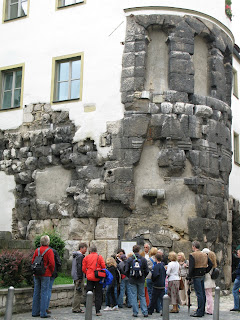


 Having missed out on a Saturday trip to Garmisch, Henry and I took the train to Regensburg on Sunday. This city of about 130,000 people suffered no bombing damage during World War II. As a result, its Old Town has remained intact. Even some stones from a Roman gateway built in 179 CE are still in place (see photo). St. Peter's Cathedral (its Gothic spires look very similar to the spires on the St. Stephans Cathedral in Vienna) (see blog "From Bad Tolz to Berlin"), the Steinerne Brucke (Stone Bridge) (with its 16 arches and dating back to the 12th century), and the Altes Rathaus (Old Town Hall) are the most prominent features of the city scape (see photos). The bridge, which crosses the rapidly flowing Danube River, was considered a masterful engineering feat in its day. We did not bother with another "cruise" on the Danube, but we enjoyed a fantastic meal at a restaurant (Silberne Gans) overlooking the river. Yes, Michelin did guide us to this restaurant!
 One other spot of note--the Place of Encounter (see photo). It marks the layout of the synagogue that was destroyed when the Jews of Regensburg where expelled in 1519. Jews had been living in Regensburg since before 1000 CE. The remains of cellars belonging to buildings in the former Jewish Quarter, as well as sections of the almost 1000 years older Roman fortress, were discovered during excavations in the mid-1990's. The Place of Encounter is intended as a reminder of Christians and Jews living together, and as a statement that today, people of all religions come together in Regensburg.

 Yesterday, I managed to fit in the return trip to Garmisch, but without Henry. Marcia took the afternoon off from work (what a good friend!) and we hiked through the Partnachklamm, a spectacular gorge near the 1936 Olympic stadium and new ski jump (see photo). The gorge is about 700 meters long, with walls about 80 meters high. Water from the Partnach River has been rushing through the area long enough to create a narrow gorge next to which a slender and sometimes slippery (from water dripping down the walls of the gorge) walking path has been built. Smooth and sharp indentations in the gorge walls show off the power of the river. Every turn provides a different view.
  At the top end of the gorge, we hiked a bit more uphill to a guesthouse sporting a fine mountain view (see photos) and offering rather decent food.
  Nestled somewhere up in the mountains sits another of King Ludwig II's houses, this one with a Turkish interior. A hike up the Schachen to Ludwig's secluded mountain retreat (about 3-4 hours each way) will have to await another day, and most likely another trip to Bavaria. Although Marcia and I had the option to take a cable car down to the parking lot, I insisted on walking back through the gorge. After all, I had to pictures in both directions! Thanks, Marcia, for a wonderful day! Rather than run off more superlatives, here are some photos, which do not come close to doing the gorge full justice.


 Getting to Promontogno was an ordeal in itself. Aside from the usual traffic exiting Munich, we came to a standstill on the Autobahn toward Switzerland (see photo of two possible future leaders of their country hanging out of the windows of their car), because of terribly inconvenient construction work. As we continued south into the Alps, the heavens opened up and it poured (except when we were driving in the countless tunnels the Swiss have blasted through the mountains). Despite the many tunnels, we still needed to drive the windy roads over several passes. Henry maneuvered the rental car (a relatively large Mercedes A180 hatchback, with automatic transmission), even though it was not the small, manual transmission car we had reserved. Perhaps the Hertz agent considered us to be her stereotypical American tourists, all of whom like to drive big cars and cannot handle manual transmissions. When the shoulderless roads are as narrow as these were, with a high cement wall on one side and a barrier on the other, the last car we wanted was one that was wider than the single lane available!
 Promontogno is peaceful oasis between the classy (assuming that is defined by the number of 4 and 5-star hotels and local branches of Hermes, Channel, Gucci, and similar shops) and touristy St. Mortiz, and the lively Italian city of Chiavenna.
  It makes no attempt to attract tourists through kitsch and gimmicky attractions.
  The village offers only its natural beauty (see photos--the view with the bridges is from our private patio outside our hotel room; also, notice the widespread use of slate as roofing material; the photo of the two of us shows more natural beauty (of course), and that the two of us actually do spend time together in the same place at the same time!). And, even better for me, it was quiet enough for Henry to permit me to keep our room window open all night!

 The best part of going to St. Moritz was our stop at Lake Silvaplana, a haven for windsurfers and kitesurfers.
 I have never seen so many of them vying for a piece of the perfect wind. I was mesmerized as the kitesurfers let the wind fill their "sail" and efffectively lift them onto their small surfing boards. The especially talented kitesurfers could hang on with one hand and could pick up enough speed to lift themselves out of the water, do an aerial twist, and land seemingly effortlessly back on the water. Unfortunately, my Canon G7 digital camera isn't quite advanced enough to capture the full scene. What I could get, however, was a sense of how intense these surfers are. They come in their RV's and camp out on the lakeshore so they can be ready for just the right wind (see photos)! The best of Chiavenna was the ice cream from Gelateria Oasi.
  The better than best were the innumerable waterfalls dropping down the mountainsides between Chiavenna and St. Moritz, as well as along the mountain pass roads. One double falls we were able to walk to was the impressive Acquafraggia, just south of the border, near Piuro, Italy (see photo). The pool at the bottom of the falls and the continuing runoff are popular spots for cooling off on a warm summer day.
 The evenings with the group were not complete until we performed karaoke (see photo). The students, who hail from an assortment of countries in addition to Switzerland (Germany, Poland, Russia, United States, Taiwan, and Turkey), were far better than we were at singing the mostly English language songs. The last evening, we were also treated to a video of the group's past two retreats. We laughed hysterically as two of the Swiss students "helped" the Taiwanese student try to master the mysteries of skiing. One held the video camera as the other skied behind their "student" while holding onto a rope around their student's waist. It was all in good fun, with everyone, including the Taiwanese student, being a great sport.
 On my suggestion, we took a detour to Arosa (another Swiss alpine ski town (see photos)), thinking it would be a short side trip for lunch. Having temporarily misplaced our detailed Swiss Michelin map, we didn't realize that the 31 kilometers to Arosa was on a tiny, windy byway. On the small Swiss map we did have, Arosa looked so close to Chur (our detour point from the main road)! Alas, a sign posted by the road as we exited Arosa announced only 355 curves ahead! Well over an hour into our "short" detour, we arrived at Arosa, hungry but very satisfied that we had encountered some fantastic scenery along the way. Our lunch at Kachelofa-Stubli, once again a Michelin red guide pick, was outstanding. I do not recall why I did not choose Arosa as a skiing destination while we were living in Zurich, but I noticed that the tram up one of the mountains was literally across the street from the train station. I am sure the train would have been a much less stressful mode of transportation to this destination resort! We had no choice but to return to the main highway the way we came, but as we "re-wound" (or should that be "unwound"?) our way back, we made several stops to take in the views at a more leisurely pace.
  Later, enjoying our view of the Bodensee from our pension in Kressbronn am Bodensee (see photo) and having dinner at Lamm im Kau in Tettnang-Kau (one more red Michelin pick), were two more treats with which to finish off our Swiss retreat.


