Without air-conditioning and only west-facing windows in our apartment, it is a welcome relief to get out and about in the warm afternoons. We invested in a fan (does anyone need a smallish circulating fan with a European electrical plug in September?), which serves a dual purpose. It provides both a cool breeze and a sound buffer against the noise of street workers during the day and cafe revelers at night. Nevertheless, I've been seeking out more comfortable venues for writing my blog--train rides to nearby lakes, boat rides on those lakes, and benches along the Isar River in the Englischer Garten in Munich have worked out well. Unfortunately, the power cord to my laptop doesn't stretch to any of these places! No worries--as Sara says, "I figured it out."

 I was drawn to the Chiemsee (lake) by another of King Ludwig II's castles--Herrenchiemsee Palace. Whatever the reasons for Ludwig's fixation with castles, he certainly knew how to take them "over the top". One can question his choice to deplete the family fortune on castle building. However, Ludwig at least succeeded in keeping keeping the money in circulation (a refrain my parents would use when viewing conspicuous consumption by rich folks) and in providing full employment for master craftsmen. Ludwig purchased Herreninsel, an island in the Chiemsee, in 1873. After twelve years of construction (Neuschwanstein Castle was under construction at the same time (see blog entry "A Week to Relax") and three others were in the planning stages), the king bankrupted his coffers and had already borrowed millions more. Twenty of the seventy or so planned rooms at Herrenchiemsee Palace were completed, including a bathtub the size of a swimming pool, a series of royal chambers just for show, and another set for personal use. The castle also contained many intricate glass chandeliers as well as a huge, but extremely delicate, chandelier made of Meissen porcelain. The walls, decorated with stucco and real marble (the stucco marble cost more to install than the real marble), elaborate wood carvings, and prominent use of gilded paint were eye-popping. Enamored with Louis XIV, Ludwig had the French king and his reign on display throughout the castle--in paintings and sculptures, and with Fleur de Lys emblems on curtains, furniture, and wood floor inlays. As was the palace, the gardens were also designed in the same manner as Versailles (see photos). One guide points out that however much Ludwig spent on his castles, the money has come back to Bavaria many times over, with millions of tourists visiting every year! At least one more "must see" castle for me is Linderhof, another of Ludwig II's castles and the only one completed in his lifetime.
 The boat ride to Herreninsel was pleasant enough, as was the ride to the "sister" island,
  "Fraueninsel". (German language scholars should get the joke--Herren and Frauen translate as Gentlemen and Women, respectively.) Fraueninsel houses a monastery dating back as far as the 8th century. Most of it has been modernized, and was not that exciting, but I found a perfect spot along the shore of the small island to enjoy my picnic lunch (see photo). This trip to the Chiemsee covered the southern part of the lake (the largest in Bavaria) and was actually my second trip to the lake.
The morning after returning from Nice, I joined Henry at a Friday afternoon to Saturday afternoon retreat of the Munich scientific group he is visiting through August. We stayed at Kloster Seeon, a few kilometers north of the Chiemsee.  The former monastery (from the 10th century) was taken over by the State of Bavaria about 20 years ago, renovated, and turned into a modern conference center for cultural and education events. While Henry did his "retreat" thing,
  I spent the first afternoon wandering around the small Klostersee (see photo) and the next morning bike riding to and along the northwestern shore of the Chiemsee. My afternoon walk led me to a guesthouse (Waltenbergstuberl) on a hill overlooking the Klostersee (see photo). As I enjoyed my Johannisbeeren Schorle (a great thirst quencher that can be nursed at least as easily as a beer) at a table conveniently situated under an eave and out of the rain, I took in the lake view and wrote some of my blog.

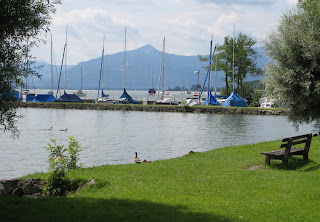
At the rate of only one euro per hour (I would have happily paid more), I could not pass up renting a bike at the Kloster the following morning and riding on the bike and walking path along the Chiemsee .  The shore was dotted with cafes and small boat docks and provided wonderful views of the lake and surrounding hills (see photos). I was also amused by the special parking for bikes sign at one of the cafes (see photo). I would have continued my ride for several more hours (the path was flat along most of the route) had it not started to rain and had I not needed to return to the Kloster for our return ride to Munich. How inconvenient!

Yesterday, I took the hour-long train ride to the Tegernsee (much smaller than the Chiemsee) and a 90-minute boat ride on the lake (no wonder I'm catching up on my blog!). The views once again were lovely (see photos), despite the overcast skies and the relatively unruly group of fourish to eightish year-old children who were not sharing very well with each other.
Our weekend trip to Garmish and another visit with Marcia and family was rained out--bummer!! I have to start packing up for a trip to San Diego. Originally, neither Henry nor I planned to be in San Diego until September, but now I am returning for a week so I can deal with a family matter. This trip is not intended as a time to visit with friends and neighbors, so I apologize in advance to all of you whom I won't be able to see. I am not looking forward to the end of our sabbatical in December 2009, but I am looking forward to picking up where I left off with friends and neighbors in 2010!
 NICEAfter returning from Berlin on my own, doing more laundry (of course), and repacking, I traveled by train to Garmish to reunite with Marcia Hampton (see photo), a friend from elementary school. A librarian for many years, she has spent most of her career working at various U.S. Army posts in Germany. The last time I saw Marcia was in Washington, D.C. about six years ago, during a two-year period when she, her husband, and two daughters lived in Virginia. That get-together followed an almost 15-year gap. Marcia ended up reapplying for the job she left in Germany, and she and her family have been there ever since. Once I arrived in Garmish (about an hour and a half south of Munich), Marcia and I immediately picked up where we left off six years ago! Neither of us skipped a beat. Except for some gray hair (mine hidden by a color rinse; Marcia's hidden by her naturally, very blond hair) and the usual aches and pains of our having passed the half-century mark in age, it was just like old times.
Seeing where Marcia and her family live (a "fixer-upper" house impressively fixed up by husband/dad/jack-of-all-trades, Larry), I can understand the draw of Garmish.  It's a tranquil town, with miles (oops, kilometers) of wanderwegs (trails) (see photo of me on our walk), mountains all around (from their house, they have a view of the Zugspitze (at 2964 meters (over 9700 feet), it's the highest peak in Germany;
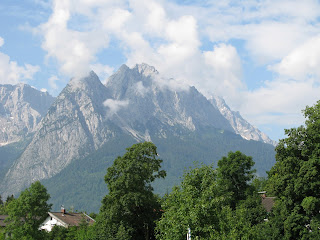 see photo--the Zugspitze is hiding behind the clouds on the right), and winter sports galore (Garmish was the site of the 1936 Winter Olympics and regularly holds World Cup Ski and Ski Jumping Championship events). After college, I moved from New York to California to escape the rat race in the Big Apple; Marcia took a different route (via Boston), for whatever her reasons. Now, Larry and she face the imminent departure of their older daughter, Lauren, for college at Wellesley. That distance certainly trumps Brett and Sara's moves to the east of I-5 for college. I explained to younger daughter, Stephanie, that the good news and bad news of her sister's leaving was that now, she would get all of her parents' attention!
 Accompanied by Izzy, a mini Lassie (she snuck into the photo of me), Marcia and I took a peaceful walk to a guesthouse, seemingly in the middle of nowhere (see photo). We savored the homemade cakes and Marcia introduced me to Johannisbeeren Schorle--a delicious mixture of currant juice and mineral water. When the downpour of rain began, we simply moved to a table underneath the eave of the building and continued our catching up. Larry prepared a yummy dinner on the grill, and chivalrously did Marcia's job of cleaning up as Marcia and I kept chatting. We took another walk in the morning (the wonderful scenery certainly makes walking the dog a pleasant chore), and on the way back to the train, Marcia drove to the Army post to show me her work digs. She has amazingly good benefits--far better than I had/have as a federal employee/retiree in the United States. Uncle Sam employs her, but also offers benefits for working abroad at the post (e.g., commissary, USPS postal rates (yes, even with the recent price increase, they are still much lower than in Europe!), moving and storage expenses, home leave, housing allowance, and Sound of Music-like surroundings). I'm glad Henry will be able to join me on a planned return visit to Garmish this weekend!
AND NICE
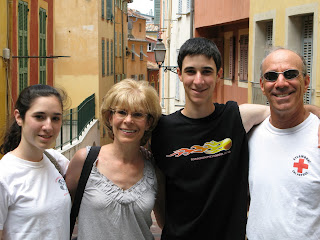 Nice is nice, and it is especially nice when I could be there with my younger sister, Linda, and her family (see photo). Following the high school graduation of Linda and Eric's twins, Lindsey and Matt, the four of them vacationed for two weeks in Paris and Nice, France. They touristed non-stop in Paris, while Nice was intended to be more restful. Having never been to Nice, or anywhere else along the French Mediterranean coast, I was eager to acquaint myself with the area. Of course, that was secondary to visiting with the Spellmans for three days! Too often, any number of them are occupied with work, school, errands, and other "to-do's". And, with Lindsey and Matt going off to college next month (Lindsey to Washington University in St. Louis; Matt to Wharton (University of Pennsylvania)), it was a perfect opportunity to spend more time getting to know them better. Lest I reveal too many family secrets, suffice it to say, I had a wonderful time.
My trip began auspiciously enough--I managed to wriggle out of a 40 euro fine while traveling on the S-Bahn to the Munich Airport. As in Zurich and other European cities, riding on public transportation is on the honor system. Randomly, however, inspectors enter the buses/trains/trams to check tickets. If you do not have a valid ticket, i.e., one that doesn't need to be punched (e.g., a monthly pass like I have) or one that must be and has been punched, the inspector fines you 40 euros on the spot. Because of the longer distance to the airport, I needed to buy a supplemental ticket to cover the additional zones. The supplemental ticket must be punched prior to boarding the train. Unfortunately, in my haste (no, I was not running late as usual!) and because I don't need to punch my monthly pass, I forgot that no punch boxes are located on the subway platform. In order to validate the ticket, I would have had to go back upstairs to where I purchased it and punch it there. Not wanting to miss the airport train and to wait another 20 minutes for the next one, I played the odds and boarded the train. Considering that neither Henry nor I had previously encountered a ticket inspector in Munich, I figured the odds were on my side. At least luck was still on my side, even when the inspector shook his head at my unpunched ticket. Playing the part of an ignorant, but well-meaning and polite American, I got off with an equally polite verbal warning!

 The airport in Nice was conveniently located on a landfill near downtown. However, I am glad my aisle seat did not enable me to see the plane banking in for the landing! The hotel (Westminster) was on the main coastal drag (Promenade des Anglais) and provided a fantastic view of the coast (see photos). Henry would have hated the place, complaining that it was too noisy! For me, the hotel was pleasingly furnished, the staff was friendly and helpful, breakfast was fine (nothing extraordinary, but could be eaten on the shaded outdoor terrace across from the ocean), and the gourmet dinner we had the first night was my favorite meal. And, my roommate, Lindsey, could not have been better! My only complaint about the hotel was that, like many older, "stately" hotels, it needed a face lift.

 Nice, with about 350,000 inhabitants, is the second largest city on the French Mediterranean coast (Marseilles is larger). For me, the city's size is a negative. Its beach is also very rocky (not a big deal to me, as I am not a beach person, and not a big deal to the many teens and twenty-somethings lining up to pay 45 euros (single) or 60 euros (double) for parasailing rides (see photos)).

 On the other hand, Nice is a good, centrally located spot from which to take trips in all directions. In addition, it has a quaint, though extremely touristed (unavoidable in the summer all over the French Riviera) Old Town (lots of narrow streets, a pretty open air flower and produce market, lots of fountains,
 several museums (Linda and I went to the Chagall Museum (good, representative collection, with an excellent audio guide to his biblical paintings)), and a hilltop of castle ruins (with current archaeological activities) (see photos).
Despite warnings regarding the hazards of driving along La Cote d'Azur, Eric bravely rented a car in order to have the flexibility of going places at our leisure. At the airport Avis office, the attendant unsuccessfully urged Eric to rent a Porsche or Mercedes sports car for just a few euros more (attaching three of us to the hood might have worked!), and then advised him of the dire consequences of not buying Avis' insurance package. Every scratch unnoted upon rental would be his responsibility--no matter that the car had not been washed prior to the rental and dirt covered pre-existing booboos. Wikitravel recommends renting a well-dinged car precisely so that new dings or scratches won't be noticed upon return of the car! Eric did yeoman service as our driver to coastal Cannes and Antibes (two nights of dinners), and to the inland towns of St. Paul de Vence and Biot on my last day. Usually the driver passing everyone, Eric drove as slowly as I've ever seen him drive on the highway. One mistaken foray onto the A8 was enough for him! The upside of keeping off the highway was that we could enjoy views up and down the coast.
Cannes and Antibes are much smaller than Nice (each has about 70,000 inhabitants), but were equally touristed. 
 Cannes' geographically defining features are the hilltop Gothic church (lit up at night) and waterfront (see photos--James Bond fans can chuckle at Octopussy 1).
  Antibes' main features are its well restored ramparts along the harbor, and its over 1,600 slip marina (claimed to be the largest in Europe) (see photo).
In Cannes, we had dinner at La Pizza (recommended by Matt) and sat on their terrace, across from the harbor. I've had too many pizzas in my life to be able to recall which was the best, but the pizza at this restaurant certainly ranked in the upper echelon. It's a good thing we were not taken aback by the notice on the menu that the pizzas are served as half circles--one half per person was more than plenty. I overheard the two women who were seated next to us ask a couple of servers to recommend the best pizzas on the menu. Taking their recommendation, I had eggplant pizza--a first for me. It was piled high with grilled eggplant and a cheese that tasted slightly sweeter and heavier than mozzarella. I was overfull after eating a little more than half of the half! As we awaited our meals, I struck up a conversation with the women next to us. We started speaking in French, and continued with a mixture of French and German after I discovered that they are sisters from Hamburg who belong to a group at home that congregates to speak in French and who came to Cannes to visit friends and practice their French. I had a grand time practicing my language skills, and by the time we were finished with our respective meals, the women accepted my offer of my remaining pizza. They simply added it to their take-home "petit dejeuner" package of aubergine pizza!
Our dinner in Antibes (La Daurade), next to the ramparts, was also excellent. The portions were huge--both Eric and Matt received entire fish, including head, tail, and fins (upon their request, the server was kind enough to remove these undesired appurtenances), and I had to leave uneaten some of my delicious fish soup appetizer so I would have room for my Nicoise salad (made with swordfish rather than tuna). Craft and jewelry purveyors were lined up along the ramparts all evening (lest a tourist need a last minute gift for that special someone), while a drumbeating music and dance group sought "tips" as they sauntered along the lane between the purveyors and restaurant terraces. Matt insisted they were the same drumbeating group we heard the night before in Cannes--they were annoyingly poor both nights! (The violin player who serenaded us during one of our lunches in a plaza in Nice was by far the best "play for pay" street musician among the many I have encountered so far this year.)


 St. Paul de Vence (about 20 kilometers west and inland from Nice) was a special highlight. It is a pedestrian only village on a hilltop, surrounded by a medieval wall. The narrow streets are "paved" with decoratively laid cobblestones (see photos). The village is a paradise for folks like Linda and me who "need" to get their fix of local color in the form of fine arts, crafts, and jewelry. We did our share of "fixing" at two shops (Galerie MJB had especially attractive blown glass), leaving euros in our wake. (We also found a very "nice" glass shop in Nice--Verre Tige.) Down to the coast and back up another valley, we found our way to Biot, a town known for its glass blowing studios. We were able to watch several craftsmen on the job, heating/blowing/shaping and heating/blowing/shaping some more. Their finished products were not as impressive as what we found in the St. Paul de Vence galleries, but the process was interesting to watch.
The Spellmans dropped me off at the airport with a tearful goodbye, but we were all amused by the special lane designated for drop offs--"kiss and fly". I did just that, but I added a bunch of hugs.
With my ambitious agenda of things to see and do in Berlin, I am glad we had a return trip planned. Despite the forecast of rain during the entire three and a half days we were to be in Berlin, we fortunately experienced more data points to demonstrate the shortcomings of weather prediction. Other than the downpour that began just two minutes before I boarded the bus to the airport (Henry left by train to Gottingen earlier in the day), most of the rain remained in the frequently threatening clouds. Improved weather prediction happens to be one of the possible applications of a theory on which Henry is working. The sabbatical gives him a chance to think deep thoughts about science (he thinks deep thoughts about me, too, so I am told!), without being interrupted by the rest of the world.I explored while Henry attended two days of meetings at our hotel (Melia--centrally located and well appointed). I started with a three and a half hour boat trip along Berlin's waterways. The city claims to have more bridges than Venice.  Whether or not that is true (I have never been to Venice), the boat took us under about 50 bridges, both old and new. Part of the trip took us through the Landwehrkanal, with several locks. Despite directions to remain seated on the upper deck because of low bridges, it was extremely difficult for a shutterbug like me to comply when we were in the open between the bridges.
  Not only did the boat tour provide a good overview of the city (I got the somewhat truncated, written English version of the German guided tour), it also provided a good vantage point to see the frequent contrasts among the restored old, the new, and the remaining shells of abandoned buildings (see photos)
 .
.


 In addition, I could see sights I would not otherwise have seen--e.g., the seemingly out of place sand, beach chairs, and umbrellas dotting the stone-sided "shores" of the canal and Spree River, students hanging out, literally, at the river's edge, satellite dishes prominently displayed on many apartment balconies, the Turkish market along the river (Berlin apparently has the world's largest Turkish community outside of Turkey), old, graffiti splattered boats docked in front of new, modern apartment buildings (see photos).
In no special order of preference, here are some destinations from my wanderings through Berlin:

 1. Pergamon Museum: The museum is named after one of its premier holdings, the reconstructed remains of the Hellenistic Pergamon Altar, dating back to about 170 BCE. The reconstructed remains of the Roman Market Gate of Miletus (from around 120 CE) (see photo) and the tiled Gate of Ishtar (from about 600 BCE) (see photo) are equally impressive. The museum also houses the Museum for Islamic Art, which includes the exquisitely paneled Allepo Room from 17th century Syria. Unfortunately, the battery in my camera lost its juice before I got to that part of the museum! If a tourist has time to visit only one of the several museums on "Museuminsel" (Museum Island), I recommend this one, hands down!2. Altes Museum: On Museum Island, and home to a collection of ancient Greek art.3. Bode Museum: On Museum Island, and home to the Museum of Byzantine Art, sculpture from the Middle Ages through the 18th century, and a numismatic collection. Neither the Altes Museum nor the Bode Museum impressed me as much as the Pergamon, but that is more a function of individual preference than quality of the respective exhibits.
 4. Berliner Dom (see photo): This cathedral was destroyed during World War II and remained a ruin for the following 30 years. It was restored in its original Italian Renaissance style and is the most imposing structure on Museum Island. I could have passed on the crypt where 90 or so sarcophagi of former Hohenzollern rulers and their families are in repose--purely a matter of personal taste!
 5. German History Museum: Entry to this museum was not covered by my museum pass, but it was more than worth the separate admission fee. The relatively recent building addition, designed by I.M. Pei (of the National Gallery (Washington, D.C.) and Louvre (Paris) fame), is gorgeous (see photo), and houses temporary exhibitions (the one I viewed was 1989: Photographs of the Turn of an Era). I was more interested, however, in the museum's treatment of the period between 1918 and the 1950's, i.e., how the rise of Hitler and the Third Reich were depicted and to what extent the displays explained if and how Germans came to terms with that era of history. Even by beginning my tour at 1918, I did not get past about 1944 by the five minutes before closing time warning. Able only to breeze through a few of the numerous additional display cases, I came away (fairly or not) with this editorialized version of the Germans' depiction of this period:a. Antisemitism in Germany and elsewhere has existed for centuries. Nevertheless, Jews fought for the Kaiser during World War I, just as did other groups who were subsequently deemed "deficient" by the Nazis. Although the number of Jews in Germany at the end of World War I constituted less than 1% of the population, Hitler took advantage of a "perfect storm" confluence of factors to blame poor economic conditions and other failings of the Weimar Republic on the Jews. Because of harsh reparations and other conditions dictated by the victorious countries in the Treaty of Versailles, Germans sought solutions in alternative forms of government. For whatever reasons (I'd like to research this question in more depth), a number of German Jews joined the Communist Party (KPD) in post-World War I Germany. Perhaps Jews were drawn to the KPD by the socialist "ideal" of equal rights--something they had been denied for centuries in different degrees in various countries. And, despite the affluence of some German Jews, many, among them Jews who moved west from Russia to escape the pogroms under the Czar, suffered the same economic woes as other Germans. In any event, in the 1920's and early 1930's, the KPD was a major political party in Germany, with representation in the parliament and generally garnering 10-15% of the vote (in other words, by the numbers alone, the KPD could hardly be considered a Jewish plot!). The KPD hoped to form a united front of the working class and to defeat the growing power of Nazi fascism. In early 1933, shortly after Hitler was appointed Chancellor, the Reichtag was set on fire. Hitler and the Nazis blamed the fire on the Communists, and took advantage of this event to give Hitler dictatorial powers. The KPD was squelched, with many Communist officials arrested and sent to concentration camps. Jews who were members of the KPD faced a double whammy.b. Having outlawed opposition parties and establishing a totalitarian single party, the Nazis used fear tactics (e.g., Dachau Concentration Camp, opened in 1933, was first used for political and other perceived opponents of the Nazi regime)) and an overwhelming propaganda machine (directed especially toward the young) to garner support and remove opposition. Whether rank and file Germans were enthusiastic Hitler supporters or not, they are portrayed in the museum as following the path of, in my words, "going along to get along". Having targets such as Jews, Gypsies, homosexuals, and the like as objects at which "real" Germans could direct their frustration and discontent, apparently was sufficient to keep the German population in check. It also helped that many Germans profited from laws forcing Jews to sell their businesses, homes, and belongings at fractions of their worth. In addition, big German business could support the war effort with slave laabor offered by the Nazis.c. Not every German was a Hitler supporter, and the museum emphasizes that opposition had its price, which most Germans were not willing to pay.d. Although various high-ranking Nazis were tried for war crimes, the trials petered out as the Cold War warmed up. As a result, many Germans who held official posts during the war were not prosecuted and they ultimately returned to their former posts.e. Some German companies have been more willing than others to pay reparations to individuals who worked as slave labor during the war.
 6. The New Synagogue (see photo): Opened in 1866, it was called "new" because it replaced a smaller synagogue. The New Synagogue housed a Reform congregation, and, with 3,200 seats, it was the largest synagogue in Germany. It clearly did not matter to Hitler that the initiation of "Reform" religious practices was an indication of Jewish assimilation as Germans. As fate would have it, the New Synagogue suffered far more damage from Allied bombs in 1945 than during Kristallnacht (Night of Broken Glass), in November 1938, when synagogues were destroyed, Jewish businesses and homes were ransacked, hundreds were murdered, and as many as 30,000 Jews were arrested and sent to concentration camps. The New Synagogue was saved from destruction by fire during Kristallnacht due, in part, to the noble oppositional act of a local police officer. He got the mob to disperse by warning that the building was a protected historical landmark, thereby enabling the fire department access to put out the fire. After World War II, the building was partially restored (including its beautiful Moorish style domes) and now houses a museum. The temporary exhibit--German Jews in Sports in the 1920's and 1930's--was especially interesting. In response to the United States and other countries threatening to boycott the 1936 Berlin Olympics, Hitler agreed to place one Jew and two half Jews to the German Olympic team. Two of these three women had already emigrated from Germany; and at least one of them had already qualified for the British team. All three had held national and/or world records in their respective track and field sports. I do not know how Hitler ensured their return to Germany (by threatening harm on other family members, perhaps??). In any event, once Hitler made these additions to the German team, the United States was placated, and the American team set sail for Germany. Once the team was on its way, and just two weeks before the games began, Hitler removed the three women from the German team. Sadly, their removal brought no further opposition from the U.S. I was also impressed by the variety of activities that took place at the synagogue prior to the war. One which stood out was the offering of emigration classes to those who were attempting to leave the country in the 1930's.
 7. Central Memorial of the Federal Republic of Germany to the Victims of War and Tyranny: A war memorial since 1931 and located in the former East Berlin, the memorial was rededicated in 1993, after the reunification of Germany. It contains the remains of an unknown German soldier and an unknown concentration camp victim from World War II. In the middle of an otherwise empty room, directly under a circular opening in the roof, is an enlarged copy of a sculpture by Kathe Kollwitz--Mother with her Dead Son (see photo). Kollwitz, who died just before the end of the war in 1945, was an out-spoken pacifist whose work often depicted the hard life of ordinary workers. In the 1930's, the Nazi Party forced her to resign her professorship at the Prussian Academy of the Arts and her work was removed from museums. The sculpture is a powerful and fitting statement of all who suffer through war and tyranny.
 8. Charlottenburg Palace, Belvedere, and Gardens (see photos): More of the same palace "stuff", dating back to the early 18th century,
  but I still enjoy it--not only the ornate interiors, but the beautiful and relaxing gardens. The Belvedere houses a nice collection of Berlin Porcelain Manufactory (KPM) porcelain, which is not among the top collections I have seen so far.
9. Brohan Museum and Berggruen Museum: There are three small museums across the street from Charlottenburg Palace. Once I was in the vicinity and with a bit of extra time, I stopped in at two of them. The Art Deco and Art Nouveau textiles, silver, furniture, and glass in the Brohan Museum did not strike a strong chord with me (personal taste again), but I was very impressed with the "Picasso and His Time" collection at the Berggruen Museum next door. Part of what sets this exhibit apart from others is the history behind it. Heinz Berggruen was a Jew, born in Berlin. Beginning his career as a journalist, he left Germany in 1936, after he was told that because of his Jewish name, his articles would be signed with only his initials. Studying art in the United States, he became an art critic for the San Francisco Chronicle. He later joined the U.S. Army, fought in the European theater, and settled in Paris after Wold War II. There, he opened an art gallery, became friends with Picasso, and ultimately became a collector in his own right. In the mid-1990s, after 60 years in exile, Berggruen accepted an invitation to display his collection (modern art previously deemed degenerate in Nazi Germany) in the refurbished building that is now the Berggruen Museum. As a gesture of reconciliation with his homeland, he donated the collection to the Berlin State Museums for a payment of approximately one-tenth of the collection's value. Bergruenn was subsequently awarded honorary citizenship of Berlin and Germany's Federal Cross of Merit.10. Winterfeldt Market: Another open air market and off the well-beaten tourist path, but a fine spot to buy fruits for my picnic lunch in the Charlottenburg Palace Gardens. This market reminded me of the Del Mar Fair (darn, I missed it this year!), in large part because I got "caught" by a purveyor of "better than anyone else's" skin products!11. Unter den Linden and Alexanderplatz: More places to wander and to see and be seen. After walking part of the Unter den Linden two weeks earlier, Henry and I walked the rest of it, traveling east toward Alexanderplatz (another tourist magnet). The western half of Unter den Linden, from Friedrichstrasse (the street on which our hotel was located, just a couple of blocks off of UDL) to the Brandenburg Gate, is prettier, maybe because it was uncomfortably warm when we walked the other way!What is particularly noteworthy about my list of sights is that, except for the market, Charlottenburg, and the two nearby museums, all of the sights are located in what was formerly East Berlin. This is a tribute to the grand efforts Germans have made to blend the two Berlins and two Germanys. Late in his life, Heinz Berggruen was quoted as saying, "I am neither French nor German. I am European. I'd very much like to think there was a European nationality, but I think I may be dreaming." Who knows what the future of the European Union may bring??Two museums I missed, but would have liked to visit, were the Kathe Kollwitz Museum (recommended by our daughter Sara, and affirmed by my viewing of the Mother with Her Dead Son sculpture at the Central Memorial to the Victims of War and Tyranny) and the Berlin Guggenheim Museum (I'm a big fan of the Guggenheim Museum in New York; unfortunately, the Berlin Guggenheim was between exhibitions and therefore closed).
One restaurant is worth mentioning--Al Contadino, an Italian restaurant recommended in an article published in the Swiss airline magazine. The place was jumping with good reason--the food was delicious!
First, here is my pitch for public transportation--it really works! The five and a half hour train ride from Berlin back to Munich was amazingly painless. The bus stop was just down the street from our Berlin hotel, and I was at the main train station in ten minutes.  (The new station building, with its modern steel and glass architectural design, is one of Berlin's structural highlights (see photo). As is the case in Zurich, Munich, and many European cities, the station houses a mall full of stores and eateries that can remain open on Sundays, despite the general Sunday closing rule. The mall looked nice enough to be inviting even if one where not just training in or out of town.) Once on the high-speed train, the time passed very quickly. All in all, the train was the better option compared to flying--I was able to get a very good fare (the advance reservation helped, though unfortunately, the train sometimes costs significantly more than flying); the seating, even in second class, was more than adequate (not generally the case on airplanes these days, except in business or first class); the schedule for the train gave me the entire day in Berlin (not so with the flight schedules); and the train station in Munich is much closer to our apartment than the airport is.
 Driving in a big city can also be a royal pain--with what seems to be an unlimited number of one-way streets and congestion throughout the city, delay and frustration are unavoidable. While I sensed that the average car size in Berlin is a little bigger than in Munich or Zurich and that there are fewer regular bicycle riders, I was amused to see that the Berlin police are doing their part to decrease their carbon footprint (see photo). I wonder whether this Smart Car is equipped with a special engine for high speed chases!
Just two days after I returned from Berlin, our dear friend, Karen Crawford, came to visit with her two sons (Ryan (14) and Jake (12)), and nanny (Rachel). Of course, having just extolled the virtues of public transportation, I was disappointed that the Munich S-Bahn let us down for the first time. With even ten-minute delays virtually unheard of, we ended up waiting at least 45 extra minutes for a train to depart from the airport into Munich. When the train finally departed, it moved slowly toward the city. An explanation for the delay was announced several times, but my German was not nearly good enough to understand it. This inauspicious beginning of the Crawford family visit continued when we arrived at their hotel, which was chosen for its proximity to our apartment. After Karen made reservations for two double rooms a couple of months ago, I went to the hotel to make sure the rooms would be up to Karen's standards. I was satisfied with the double room I was shown, but when we finally arrived at the hotel, the two rooms were approximately the size of our daughter Sara's double dorm room her first year of college. The two rooms, which together were smaller than the room I was shown, even looked like dorm rooms, with old furnishings, tattered carpet, and two single beds placed along opposite walls. However, unlike dorm rooms, these rooms lacked space for a second desk and closet! Worse yet, the rooms were two floors away from each other. Had I seen these rooms during my visit, they would not have met my standards (which might be a teeny bit lower than Karen's), and our friends would be staying at a different hotel. Little did the young reception desk attendant know she would be facing the one-two punch of two irate California lawyers! Of course, there were no rooms available that were similar to the one I previously viewed (maybe that room was used only for the hotel website photo gallery (which Karen had taken to be an accurate rendering of the reserved accommodations)). By the time Karen and I were done with the poor attendant, Karen had two large triple rooms next door to each other.
 For those of you who know Karen, you would have been amazed how easily she adapted to the rainy weather we endured during her entire stay in Munich--no umbrellas for the Crawford family, they just donned their waterproof windbreakers with hoods and they were ready to rock and roll (see photo)! The rain prevented us from dining al fresco (no "biergartens" for Karen, but she got her "bier"!), but everyone was a good sport. Henry was able to join in the Crawford visit only for the first evening--he left the next morning for Washington, DC, where he had to give a 20-minute presentation to an unnamed agency. The agency was requiring all recipients of a purported five-year grant to justify continued receipt of funding for the fourth and fifth years of that grant. We all missed Henry's company, but managed to be tourists without him.
With two full days available, the Crawfords opted for a visit to the Dachau Concentration Camp Memorial on the first day and a tour of the Munich BMW plant on the second day--an interesting combination. Karen was the force behind the visit to Dachau. As she explained to Ryan and Jake, it's like having an elephant in the room--if you are in the room, it is impossible to ignore the elephant. In the same manner, with the Dachau Concentration Camp on Munich's doorstep, visiting it is a "must". I'm not sure how much understanding Jake took away from the visit, but Ryan was engrossed. I took the opportunity to complete my tour of the Memorial's museum; I spent the rest of the time wondering what brings a nation to engage in genocide, and what is necessary to change that perspective. The song from the musical "South Pacific", " You've Got to be Carefully Taught", came to mind. As the young lieutenant sings, racism is not born in you; it happens after you're born. The same can be said for other types of hatred.
 BMW is headquartered in Munich and has built an impressive showcase for the public (see photo--Jake, Rachel, Karen, and Ryan happen to be in the foreground!). They have a large display of concept cars as well as a museum. In addition, they have a plant on site and offer tours. Karen is a current BMW owner and has had several of them over the years. While one might think that Ryan and Jake pushed for the BMW tour, Karen enthusiastically suggested it! The two and a half hour tour was comprehensive, with Jake hanging on every word. At every stop on the tour, he wiggled his way up to the front of the group. Ryan, on the other hand, wanted to take pictures of the concept cars. I walked away with discomfort. Several things contributed--I was reminded the day before, at Dachau, that BMW used slave labor in its plants during World War II; one of the buildings we toured at the plant was in operation since the1920's; the staccato tone with which the tour guide (about my age) spoke English was almost too precise and orderly; the introductory movie about the company's history glossed over the World War II period, saying only that the company had to be rebuilt after the War; and the guide was rather ill at ease when I asked, after the tour was over, what was built at the BMW plant during World War II--he tried to sidestep the question and finally offered that he supposed "army cars" were produced. He was not at all comfortable with my having brought up the subject. My own discomfort was not necessarily consistent with my having owned a German car in years past (a Volkswagen Rabbit), but it was present nevertheless.
 While "touristing" around with Karen and company, I finally got to see the figurines in the clock tower of the "new" Rathaus in Marienplatz do their dance, as the glockenspiel chimed on the hour. For whatever reason, they dance only at 11AM, noon, and 5PM. Watching them is one of those little thrills that brings a smile to everyone's face, even after a day at Dachau. The visit with Karen was short, but we did get to hang out together and "tawk" in the evenings, while Rachel stayed with Ryan and Jake at the hotel. Especially after seeing Karen "on vacation" with the boys, I continue to marvel at how she manages to keep all the juggling balls in the air--as a widow, a partner in a law firm (not only working cases, but having to bring in new business as well), and as a mother of two teenage boys. They are good kids and Rachel is great, but boys are definitely a handful. Henry and I were spoiled by having girls. We didn't have to deal with them wrestling in the subway station perilously close to the train track!
 With just a couple of days in Munich between the Crawfords' leaving and my meeting Henry at the airport for our trip to Berlin (he arrived back from Washington on Monday morning (6/29), with just enough time to wash up at the airport and catch the next plane), I made it to another nearby group of palaces (Alte Schloss Schleisheim, Neues Schloss Schleisheim, and Schloss Lustheim, which date back to 1600 and 1700). Maybe I am starting to get "schlossed out" after visiting so many of them, but these palaces were not as exciting as most of the others I have visited. Nevertheless, the gardens were very impressive (see photo), as was the exhibit of Meissen porcelain in Schloss Lustheim.
  Also, were I not already tired, I would have stayed into the evening to attend a classical music concert to be held in one of the halls of the Alte Schloss. The Baroque adornments on the walls and ceiling of the hall made it an inviting offer (see photo). The following evening, I attended a movie at the annual Munich Film Festival. Yes, the movie was in English (I would not have gone otherwise). It was amazing how much of the German subtitles I understood when I heard the spoken English at the same time! After so many years of missing out on film festivals in San Diego, I finally made it to one half way around the world.


 I was drawn to the Chiemsee (lake) by another of King Ludwig II's castles--Herrenchiemsee Palace. Whatever the reasons for Ludwig's fixation with castles, he certainly knew how to take them "over the top". One can question his choice to deplete the family fortune on castle building. However, Ludwig at least succeeded in keeping keeping the money in circulation (a refrain my parents would use when viewing conspicuous consumption by rich folks) and in providing full employment for master craftsmen. Ludwig purchased Herreninsel, an island in the Chiemsee, in 1873. After twelve years of construction (Neuschwanstein Castle was under construction at the same time (see blog entry "A Week to Relax") and three others were in the planning stages), the king bankrupted his coffers and had already borrowed millions more. Twenty of the seventy or so planned rooms at Herrenchiemsee Palace were completed, including a bathtub the size of a swimming pool, a series of royal chambers just for show, and another set for personal use. The castle also contained many intricate glass chandeliers as well as a huge, but extremely delicate, chandelier made of Meissen porcelain. The walls, decorated with stucco and real marble (the stucco marble cost more to install than the real marble), elaborate wood carvings, and prominent use of gilded paint were eye-popping. Enamored with Louis XIV, Ludwig had the French king and his reign on display throughout the castle--in paintings and sculptures, and with Fleur de Lys emblems on curtains, furniture, and wood floor inlays. As was the palace, the gardens were also designed in the same manner as Versailles (see photos). One guide points out that however much Ludwig spent on his castles, the money has come back to Bavaria many times over, with millions of tourists visiting every year! At least one more "must see" castle for me is Linderhof, another of Ludwig II's castles and the only one completed in his lifetime.
 The boat ride to Herreninsel was pleasant enough, as was the ride to the "sister" island,
  "Fraueninsel". (German language scholars should get the joke--Herren and Frauen translate as Gentlemen and Women, respectively.) Fraueninsel houses a monastery dating back as far as the 8th century. Most of it has been modernized, and was not that exciting, but I found a perfect spot along the shore of the small island to enjoy my picnic lunch (see photo). This trip to the Chiemsee covered the southern part of the lake (the largest in Bavaria) and was actually my second trip to the lake.
 The former monastery (from the 10th century) was taken over by the State of Bavaria about 20 years ago, renovated, and turned into a modern conference center for cultural and education events. While Henry did his "retreat" thing,
  I spent the first afternoon wandering around the small Klostersee (see photo) and the next morning bike riding to and along the northwestern shore of the Chiemsee. My afternoon walk led me to a guesthouse (Waltenbergstuberl) on a hill overlooking the Klostersee (see photo). As I enjoyed my Johannisbeeren Schorle (a great thirst quencher that can be nursed at least as easily as a beer) at a table conveniently situated under an eave and out of the rain, I took in the lake view and wrote some of my blog.

 The shore was dotted with cafes and small boat docks and provided wonderful views of the lake and surrounding hills (see photos). I was also amused by the special parking for bikes sign at one of the cafes (see photo). I would have continued my ride for several more hours (the path was flat along most of the route) had it not started to rain and had I not needed to return to the Kloster for our return ride to Munich. How inconvenient!


